ARTE TEDESCA TRA LE DUE GUERRE                                                                                    GERMAN ART BETWEEN THE TWO WARS                                                                                    DEUTSCHE KUNST ZWISCHEN DEN ZWEI KRIEGEN


Video Campolmi 1974

Video 1974

Video Ronsisvalle 1975

Video 1975

Video 2001

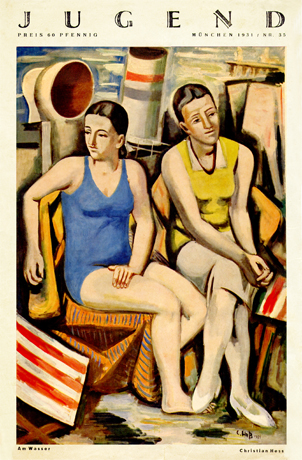
Louis Christian Hess

(Bozen 1895 - Schwaz 1944)


A protagonist of the Munich Art, a citizen of Europe par excellence, he traveled and worked from Scandinavia to Sicily, but the Nazi tragedy chased him like a curse.
 

… while at Innsbruck his young life was being shattered by an air strike, in Sicily his sister Emma was putting his paintings out of harm’s way by taking them to anti-aircraft shelters...
 

We are looking for his works scattered throughout Europe, as well as those that he failed to sign in order to escape the Nazis after the Munich Glaspalast fire, and the ban placed on the Juryfreie of which he had been a leading force. 


Historical ambit

Glaspalast

Juryfreie

Entartete Kunst

Max Beckmann

Karl Hofer

George Grosz

Otto Dix

Ernst L.Kirchner

Studies & Researches

WORKS OF HESS
RECOVERED
IN BRUNICO


C. Hess - Messina Oil on canvas, 1928, cm. 61 x 76,5

At the Town Museum of Brunico took place from July 19th to October 21st, 2007 the Exhibition “In the mirror of the reality” that included five works of Christian Hess, 3 of them - considered scattered - have been “recovered”, the other 2 are new discovery added just now to the repertory of the german Painter. The 5 works of Hess are pubblished on the Catalog “Im Spiegel der Wirklichkeit” by Art Editions Haas, Vaduz 2007. Here is one of the works discovered in Brunico and illustrated on the invitation card of the Exhibition:


C. Hess – Metaphysical still-life, 1928, mixed technique on paper, cm. 42 x 62

THE PROPHECY OF THE “SPHINX”


Among the sculptures by Christian Hess, a nearly prophetic significance should be attached to this definitely peculiar “Sphinx with Lola’s face” modeled with the sand of the Baltic at Wismar (summer 1929): just as the wind swept away the grains over the shore after just a few hours had elapsed, a few years later in just the same way the Nazi ostracism endeavored to disperse Hess’ works, particularly the sculptures, since it was hard for the artist to transfer them during his movements in search of asylum from Switzerland to Sicily and vice versa.


NEW DISCOVERIES
OF HESS’ WORKS


Bozen Piazza Grano (1915). Xylography painted with watercolors cm. 10.5 x 11.5

Between 2004 and 2006, the Christian Hess Cultural Association has found in Germany, Austria and Italy the images of a hundred finds (documents and works) of the German Maestro that had been fully unknown in the 1970’s, when the traveling exhibition of the rediscovery was organized.


Natura morta con vaso, brocca e rami di alloro. Guazzo cm 42 x 33 (Austria 1918)

While the general catalogue of the works by Christian Hess is being prepared, with a view to finding additional documents and works, the Association continues its studies and invites the visitors of the site to cooperate in the research effort.


Boats on the beach (Messina, 1932). Oil on canvas cm. 79 x 98.

ROME DISAPPEARED
BY CHRISTIAN HESS


This picture by Christian Hess, executed in Rome in 1930, reproduces a foreshortening of the “San Lorenzo quarter” that disappeared on July 19, 1943, following an air strike of the American bombers that caused three thousand victims. In fact, a study carried out in Rome by the Christian Hess Cultural Association succeeded in establishing that the only element of the picture that was still recognizable was the surviving smokestack that, in the postwar period, had been included, as an industrial archaeology relic, in the construction of the building of the Department of Genetics and Molecular Biology of the National Research Center.


The gigantic smokestack was a part of the Wuhrer (the former Patzkoski) beer factory, located at the corner between Via degli Apuli and Via dei Sardi, which was hit by incendiary bombs and destroyed by the flames. Therefore, the title of this painting by Christian Hess shown in the Catalogue of the Rediscovery Exhibition (Palermo, 1974) as “Piazza Navona” (an area that, after all, had been free from industrial smokestacks) should be considered incorrect, being instead a spot in the San Lorenzo quarter as the German painter saw it in 1930 and painted it on canvas.

Events

Heinrich Zille the man
Cartoonists from...
Camping women...
Female impressionist
Painting: the hidden...
Wonders of Babylon...
Von Daguerre bis DVD

CULTURAL ASSOCIATION CHRISTIAN HESS - ROME ©