|
The
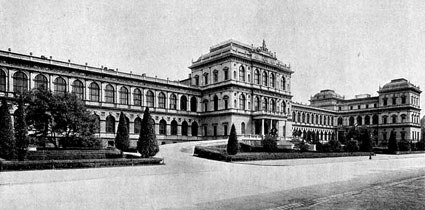
Munich Academy of Fine Arts, designed by Gottfried von Neureuther, was
completed in 1884 in the district of Schwabing. Christian Hess studied
here from 1919 to 1924 under Professor Carl Johann Becker-Gundhal.
Founded in 1770, by the early 19th century the Academy was second only
in importance to the Academies in Paris and Dusseldorf. Munich was
considered the artistic capital of Central Europe: the city exerted
enormous artistic influence over a vast area from Scandinavia to Russia,
from Poland to Greece and could boast a special relationship with
Hungary.
|
 |
|
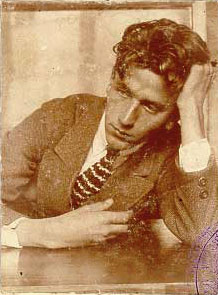
Louis
Christian Hess (1921) the photo from his student card at the Academy |
 |
In the mid-nineteenth century
when the importance of the Dusseldorf Academy was waning, the Munich
Academy began to attract growing numbers of students from throughout
Europe and the United States.
The Bavarian capital
attracted a host of young artists who were destined to become leading
members of the most radically modern art movement. At the end of the
19th century the Munich Academy welcomed students such as Lovis Corinth,
Emil Nolde, Otto Müller, Wassily Kandinsky, Alfred Kubin, Christian
Schad, Alexander Kanoldt, Paul Klee, Franz Marc, Josef Albers, Richard
Riemerschmid and Bruno Paul.
|
 |
|
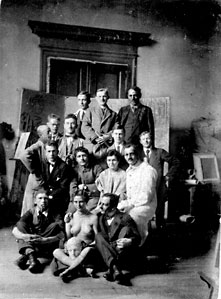
Akademie der Bildende Kunste Munich - 1919.
Prof. Becker-Gundhal's drawing class.
Hess is
the first on the left, second row. |
Here, from 1919 Christian Hess was to forge his
artistic talent. (On the right Hess in a group photo of students from
Prof. Carl Johann Becker-Gundhal’s class).
In the first half of the 1930’s the international prestige of the
Academy rapidly declined, as it submitted to the artistic tenets of
National Socialism. But, following the mysterious blaze at the Munich
Glaspalast in which some of his own works were destroyed and the growing
threats from Hitler to ban the avant-guard Juryfreie movement of which
he was a leading member, Hess had already fled Bavaria and sought refuge
in Sicily. His continuous wanderings finally took him to Innsbruck,
where he was to die of injuries sustained in an air-raid on the city at
Schwaz Hospital on 26 November 1944. In Munich allied bombings severely
damaged the Academy. Its archives were destroyed, along with its vast
collection of paintings and historic costumes. The destruction left no
trace of the works produced by Christian Hess during his years of study
at the Academy.
Fortunately the contents of the Academy’s vast library
were transferred for safety reasons before the worst of the bombings.
The magnificent 90,000-volume collection was saved and now forms one of
the world’s most important art libraries.
|
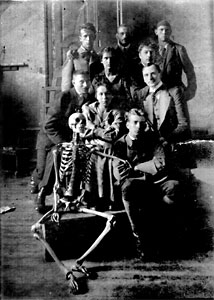
Students pose with a
skeleton |
|
 |
 |
|
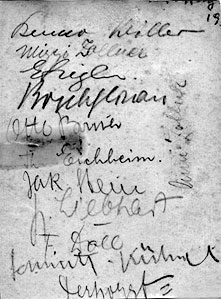
Munich 1919 - A group of students at the Akademie der
Bildende Kunste pose with a skeleton. Christian Hess is
first on the left, back row. On the reverse side of Hess'
copy of the photograph are the signatures of his fellow
students. |
In 1948 the Academy was merged with the schools for arts-and-crafts and
applied arts and new educational guidelines laid down which are still in
force today, each separate discipline being taught in specialist
courses.
In the 1960’s a school of interior design was
opened, followed by a faculty of architecture. Courses in visual arts
and art therapy were to follow.
L’Akademie der Bildenden Künste is twinned with a number of
European art academies including l’Accademia di Brera in Milan. It is a
participating member of the Erasmus Programme which promotes
international student exchange.
|